Welcome to Belmont Acres Farm!

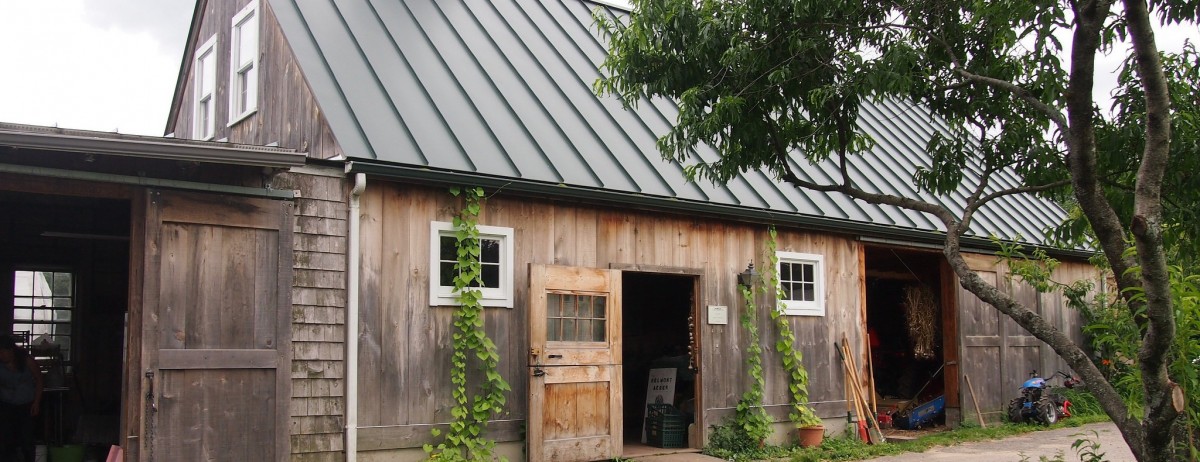
We are a 5-acre, family-run farm located right outside of Cambridge. We’re committed to growing the tastiest, healthiest produce available with sustainable methods, emphasizing an ecological, holistic approach to agriculture.

Summer CSA Shares now available!

We operate a CSA and Farmstand in Belmont, MA; you can find directions to us here. For more information about our growing practices, check out our About page, and if you have any questions, don’t hesitate to drop us a line!


Exciting Week on the Farm

This past week has been a blur: we’ve been out in the fields and the community– it’s been great!

We’re in the middle of a big push to get plants out into the fields, even though there was a frost advisory this week (can you believe that??) We’ve got our spring brassicas in the ground (kale, broccoli, cauliflower, cabbage, horseradish, and bok choi), planted more potatoes, more onions, plus tomatillos and the beginning of our tomatoes. I’m so excited about those tomatoes! Taking them out to be planted, I was overwhelmed by the unmistakable smell of tomato–too good! They look super happy and healthy, nestled in their salt-marsh-hay mulch. Photos and words really can’t describe the beauty I see in the soft undulations of a hay-mulched field.

We also had a class from one of the local elementary schools in to visit on friday. The kids had a blast!! Abby has been working with the Belmont Public schools on various farm-related educational projects, and I’m really looking forward to her blog-post about them.

Today was Town Day in Belmont, and Abby and I spent a few hours handing out flyers and meeting people. One of the great shames about this farm is what a well-kept secret it is, but we made some headway in righting that today.

Bringing me to my next point…

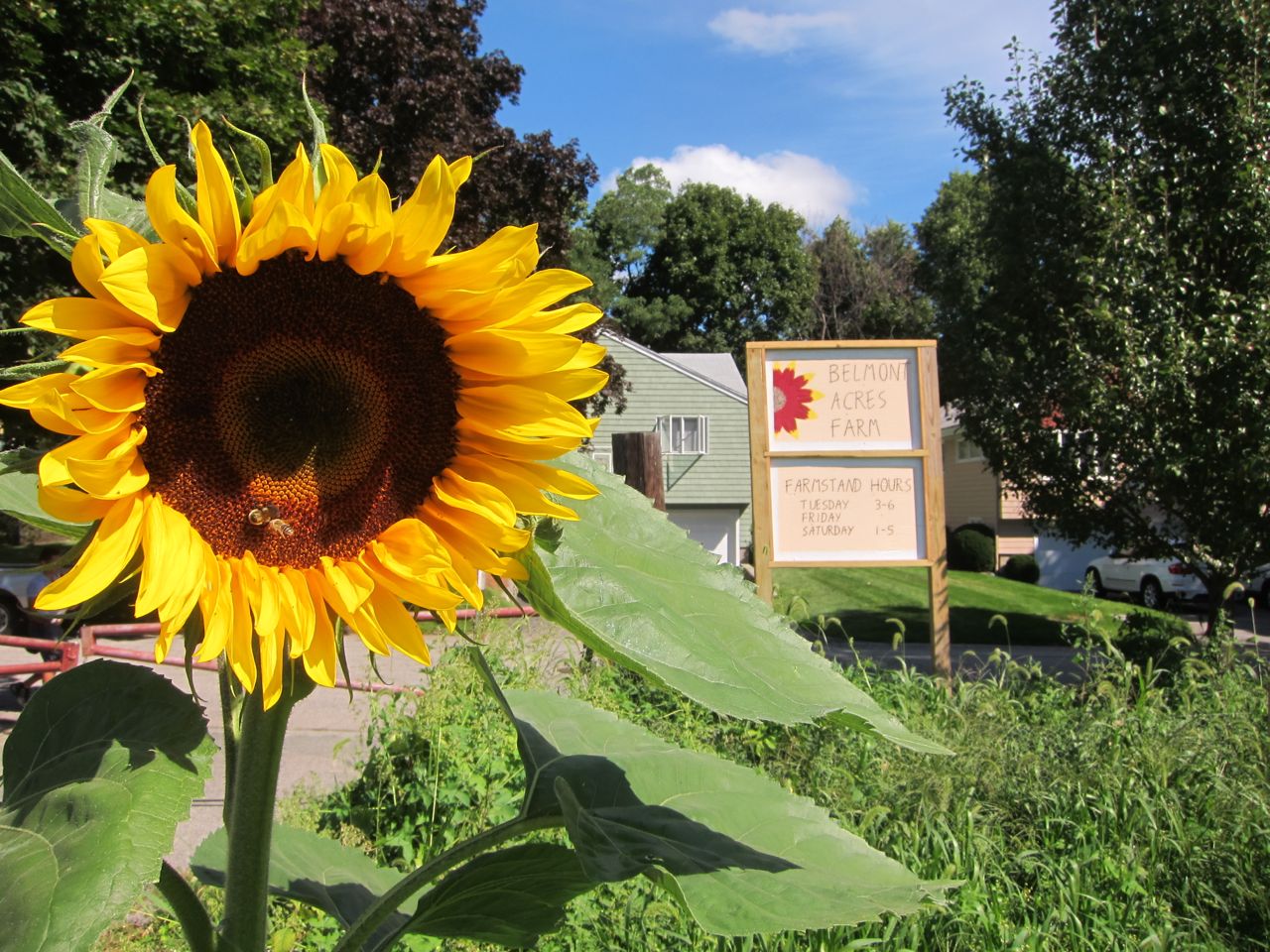
Belmont Acres has a sign!

It’s rather dashed together– I made it this morning for Town Day– but it exists! We’ve been getting a number of people wandering in during the day, wondering what the heck we’re doing with all this land in the middle of the burbs. So now they know– we’re getting signs dirty and growing food!

Just for fun, here’s a little gif I made of me spray-painting the sign:

So that’s all for now. If you’re reading this and you came here via Belmont Town Day, thanks for checking us out! We hope to see you on the farm this season. Spring is in the air, and we’ll be ready to open the stand any minute now– stay tuned for updates!

The Bees of Belmont

Here you can see the queen cage and the hundreds of bees crawling on it and the frame its suspended from.


Happy Spring everyone! We’re pleased to announce the addition of two new beehives on the farm! The bees arrived and were installed this Easter [Beester], and have since settled in nicely on the farm. It’s such a pleasure to see our coworkers busily collecting pollen and nectar in the chickweed and pear tree blossoms!

Our bees have a few important features [beetures?] that make them very special, at least to us! First of all, we have northern queens. This means our queens are bred from bees that have successfully maintained a healthy hive through a cold New-England winter. They also come from stock known for having good bee-instincts, like hygiene and propolizing. Our bees are also raised on foundationless frames, meaning they build their own comb, rather than drawing wax on a foundation we give them.

We’re experimenting with naturally drawn comb in hopes that it will lead to a more robust colony. Some people believe that small-cell bees are more resistant to Varroa mites, although this has not been proven empirically. The thought is that bees raised on larger cells [as are found in standard foundation] take an extra day to emerge from their brood cells, where the mites reproduce [both of these statements are definitely true]. This gives the mites an extra day to lay their eggs, thereby increasing the varroa population. So reverting to natural cells may give the mites less time to reproduce, helping the bees control the varroa population. This has only been seen anecdotally, but I personally think that when you’re dealing with such a complex system as a bee colony, it’s better to futz with it as little as possible. So natural it is! Going foundationless also means we’re not exposing the bees to pesticide and chemical build up, found in wax foundations. For more about converting a standard hive to foundationless, check out The Honey Bee Suite, which has lots of good pictures and information.

Going foundationless can be a little tricky, though! The first time I  opened up the hives , I discovered one of them much preferred the roof to the frames I had so thoughtfully provided, and had begun to build their comb off of it! I had to perform some minor hive-surgery, cutting the comb off of the roof and tying it into a frame. They were not super happy about it! But they’ve since forgiven me, and returned to their springtime work, building comb and collecting pollen and nectar. Soon enough I will check in on them again, to see if they need some more space to expand into.

Winter Happenings on the Farm

Ally, Abby, Mike and Hermik


Summer Shares for 2013 Now Available!!!

Welcome to 2013 on Belmont Acres Farm!

The goats and chickens are less than pleased with all the snow we’ve gotten, but even under two feet of snow there’s plenty for the farmers to do! Farmer Mike has been busy taking apart and reassembling the tractor for easier use this season. Although we contemplated upgrading, purchasing new equipment is expensive and challenging to find the tool that best meets our needs. We’ve decided, at least for the time being, to upgrade parts in an attempt to make ours easier to use. Mike’s currently working on trying to install hydraulics so that the plow is easier to use. Last season it was a little too challenging for some of the weaker members of the herd (yours truly), so hopefully this year it will be more accessible to all and we can divide the physical sufferings evenly!

We have been busy at work putting together seed orders and determining what to grow and where this year. We’re expanding our already plentiful potato crop with a few new and funky varieties with the intent of having new potatoes hopefully in early June and have picking out old favorites as well as some new experimental crops this year. We decided to not throw in the towel on artichokes just yet despite a challenging crop in 2012. The heat came at just the wrong time and we, unfortunately, didn’t have enough to put in shares let alone eat ourselves. We’re bringing back favorites like okra (yes, it’s a favorite!), lettuce, arugula, tomatoes, and snap peas, as well as expanding into new and unchartered territory! I’m most excited for black beans, parsnips, and hopefully a better crop of winter squash this year. We’re also doing our best to expand herb production and diversify our hot pepper selection! No matter the time of year, there’s always lots to be doing to keep up with the season!

This year, in addition to our 2012 crew we are excited to welcome Hadley Piper as our new intern for the 2013 season. Hadley comes to us from the Belmont community with a shared passion for creating an innovative and sustainable farm ecosystem, and we are excited to have new hands on deck to make this season even more fruitful than last!

Don’t forget to get your check in to be a part of the 2013 season with a CSA share, and stay tune for updates on stand hours and produce availability! We are excited to share this season with you all!

A New Farm, a New Direction

Welcome to Belmont Acres Farm, a small farm run by a family located in Belmont, Massachusetts. We offer CSA shares, direct sales to local restaurants and markets. We also operate a farm stand on the property.

We are not a certified organic farm but use farm generated compost and employ drip irrigation to create a more sustainable agricultural model. Building a healthy soil is key to growing healthy vegetables and flowers!

Concerned how your produce is grown?  Stop by and ask us how we grow ours.